The "Skill Gap" — The Real Crisis of the Labor Market
What Is the Skill Gap?
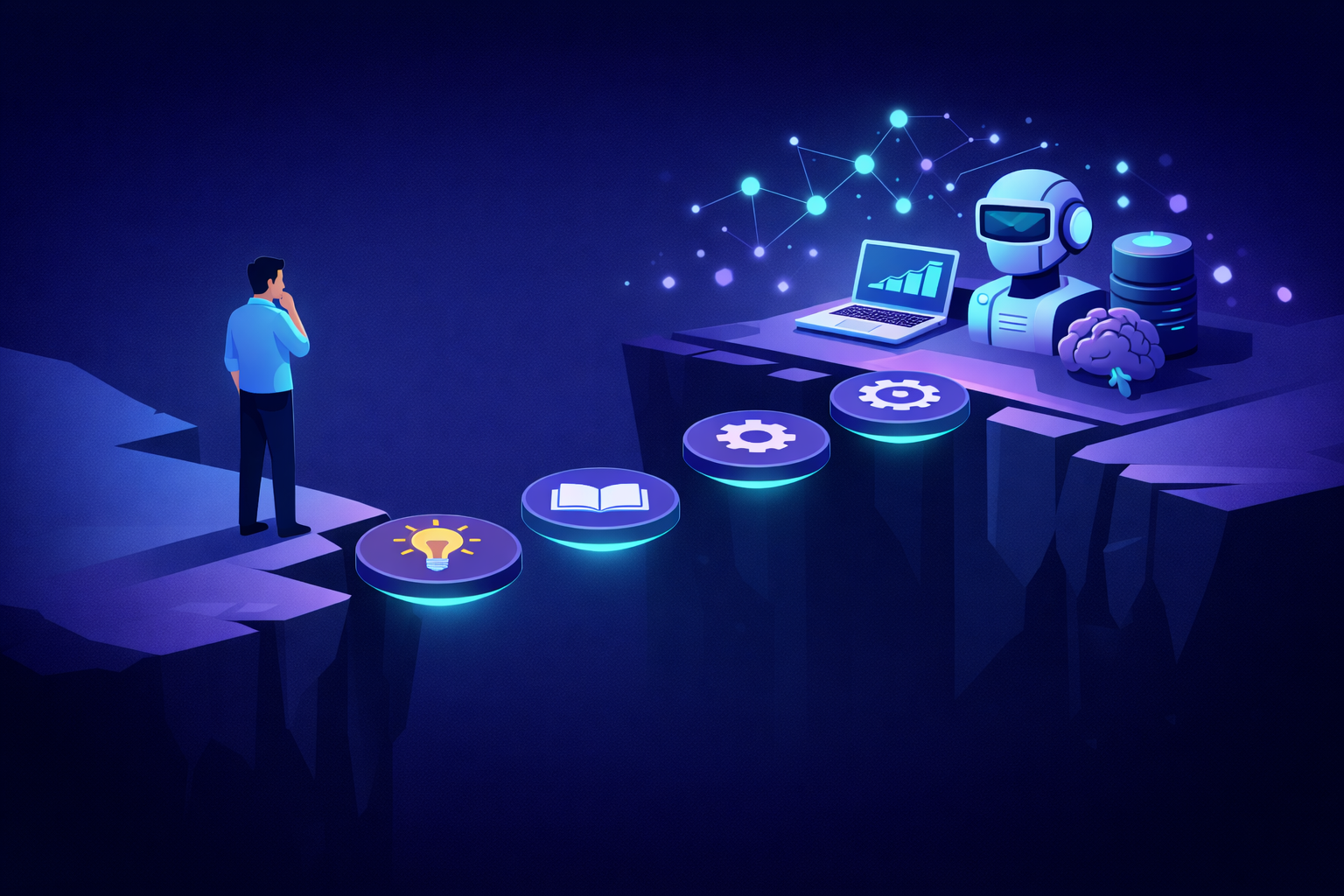
The skill gap is the chasm between an employee's current abilities and the skills demanded by the labor market. This isn't a new phenomenon — but in the AI era, it has dramatically accelerated and widened.
According to McKinsey's 2025 Global Skills Report:
- 68% of employees feel their current skills won't be sufficient within 3 years
- 87% of executives are already experiencing a skill gap in their organizations — right now
- The average "skill half-life" (the time a learned skill remains relevant) has dropped from 5 years to 2.5 years
This means: what you learn today will need refreshing within 2-3 years. It won't become obsolete — but it won't be enough on its own.
The 3 Types of Skill Gap
Not every skill gap is the same. In the AI era, we can distinguish three main types:
Most people struggle the most with the third one. Technology isn't the barrier — our own response to change is.
How AI Is Rewriting the Map of Valuable Skills
What AI Has Already Taken Over — and What It Never Will
In 2026, we don't need to predict — just look around.
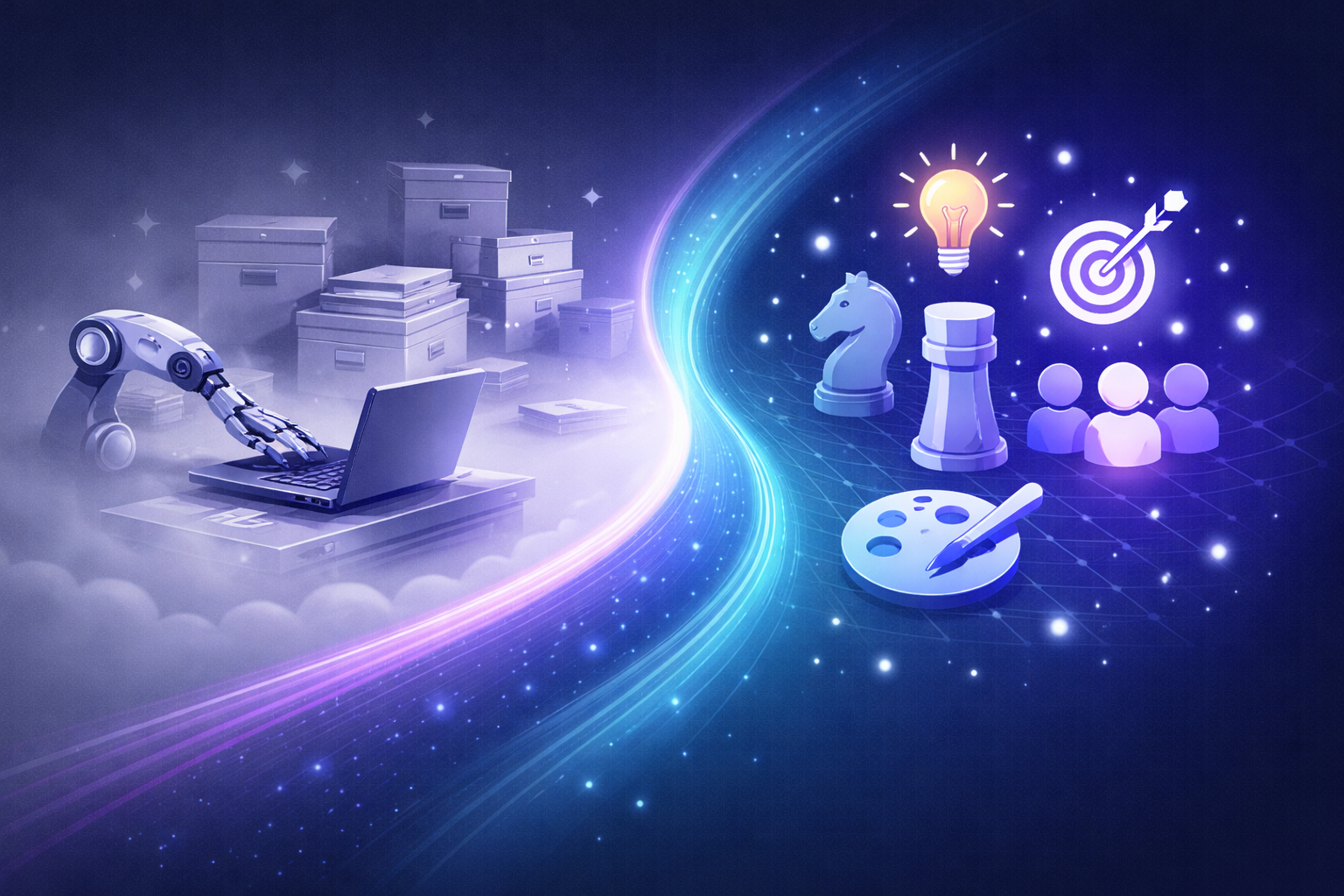
The pattern is clear: AI takes over routine, and everything uniquely human appreciates in value. But here's the twist: most people's careers are defined by routine tasks. Someone who's been preparing reports for 15 years — that's their identity. And now AI generates one in 5 minutes.
The question isn't whether you'll have a job. It's whether you can create new value when your old tasks disappear.
Self-Awareness as Career Strategy
Why Self-Awareness Is the First Step
Most career advice goes: "Learn AI!" That's true, but incomplete. Because if you don't know where you stand now, you can't know what to learn.
Self-awareness in the AI era has become a strategic career tool:
- Skills inventory: What can you do now? What are your strengths? Which routine tasks are you good at that AI can also handle?
- Interest map: What do you enjoy doing? What motivates you? When are you in flow?
- Value map: What value do you create through your work? What can truly only you do, and what's replaceable?
- Learning style: How do you learn most effectively? Online? With a mentor? Through practice?
The Evolution of the "T-Shaped" Skill Model
The familiar T-model (broad foundational knowledge + one deep expertise) is transforming. By 2030, the Pi-model (π) will be the strong bet:
OLD: T-model                      NEW: Pi-model (π)

     ████████████████                  ████████████████
           ██                          ██            ██
           ██                          ██            ██
           ██                          ██            ██
           ██                          ██            ██

     Broad base +                Broad base +
     1 deep expertise            2 deep expertises
                                 (profession + AI/digital)
This means: the strong employee of the future stands on two legs. One is their professional domain (medicine, law, marketing, finance, craftsmanship — anything). The other is digital/AI competency, which enables them to apply their expertise more effectively and at scale.
The Most In-Demand Skills of the Future
Hard Skills — What Can Be Taught
Soft Skills — Developable, but Not from Textbooks
The key insight: Soft skills aren't "nice-to-have" extras — they're the hard currency of the future. Because these are exactly what AI can't replace.
The Skill Gap Differs by Industry — Where Do You Stand?

The skill gap isn't the same for everyone. Your industry, your role, and your career level fundamentally determine which gaps you face.
Service Sector (Beauty, Wellness, Fitness, Hospitality)
The surprise: In this sector, the skill gap isn't in professional expertise — that's already there. It's in digital self-service and business thinking. An excellent hairdresser who doesn't manage their Google reviews and doesn't use online booking is invisible to the under-35 demographic.
Administration and Office Work
The challenge: This is the sector most affected by AI automation. 60-70% of office routines are automatable. But this doesn't mean office roles disappear — it means they fundamentally transform: from executor to analyst, from data entry clerk to decision preparer. Those who make this transition become more valuable than ever.
IT and Technology
The paradox: In the IT sector, the skill gap runs in the opposite direction — it's not technical knowledge that's missing (AI helps with that), but soft skills: communication, customer understanding, teamwork. The best developer in 2030 won't be the one who writes the most lines, but the one who best understands WHAT to build and WHY.
Finance, Accounting, Legal
The trend: The "billable hours" model is transforming. If AI completes in 5 minutes what used to take 3 hours, the client won't pay for 3 hours. The business model shifts: the client pays for knowledge and decisions, not for time.
Healthcare
The Psychology of the Skill Gap — Why Don't We Start?

The 5 Most Common Mental Barriers
The biggest obstacle to closing the skill gap isn't money, time, or talent. It's the blocks in our heads:
1. Impostor Syndrome — "I'm not smart enough for this"
"AI is too complicated for me. I think everyone else gets it, just not me."
Reality: "Everyone else" is also learning. Most people who confidently use AI today had no clue about it 18 months ago. The difference isn't talent — it's that they started.
2. The "I'm too old for this" myth
"This is a young person's thing. I'm not going to learn new technology anymore."
Reality: The best AI users aren't the youngest but the most experienced — because expertise + AI = superpower. A 50-year-old accountant who learns to use AI is worth more than a 25-year-old who only knows AI but not accounting. Experience isn't a disadvantage — it's the biggest advantage, when paired with openness to new tools.
3. The "I'll wait until it's ready" procrastination
"I'll wait until it becomes clear which tool is the best."
Reality: It'll never be "ready". AI is constantly evolving. Those who wait for the perfect moment will never start. The best time to begin is always now — because learning is cumulative: what you learn today is useful tomorrow, even if the tools change.
4. The "I don't have time" illusion
"I'm so busy I don't have time to learn."
Reality: 15 minutes a day → 1.5 hours a week → 6 hours a month → 72 hours a year. In that time, you can learn an AI tool for your work. The question isn't time — it's priority. Ironically, AI itself would save the very time you'd need for learning.
5. The fear of "identity loss"
"If AI does what I used to do, then who am I?"
This is the deepest and most rarely spoken fear. When we hand part of our work to a machine, we also have to let go of a piece of our professional identity. The report writer who's been proud of this skill for 15 years finds it hard to accept that AI does it in 5 minutes.
The answer: Your identity isn't in your tasks — it's in the value you create. The report writer's real value was never filling in the spreadsheet — it was knowing what the data meant. AI takes over the filling — but understanding, interpretation, and decision-making remain.
The 4 Types of Relating to Change
Based on CompTIA's 2025 survey of European office workers.
The good news: The type isn't permanent. Anyone can shift toward the innovator end — with one decision, one first step.
The Anatomy of Career Change in the AI Era
When Is a Career Change Needed — and When Not?
You DON'T need to change careers if:
- The essence of your profession remains human (teacher, therapist, social worker, doctor, etc.)
- Your routine tasks are automatable, but your expertise isn't → you need upskilling, not a switch
- You love what you do and are willing to integrate AI tools
It MAY be worth changing careers if:
- 90%+ of your work is routine, and AI can fully replace it
- You're not interested in your field, and the AI transformation is a good opportunity for a fresh start
- You work in a structurally shrinking area (not because of AI, but market forces)
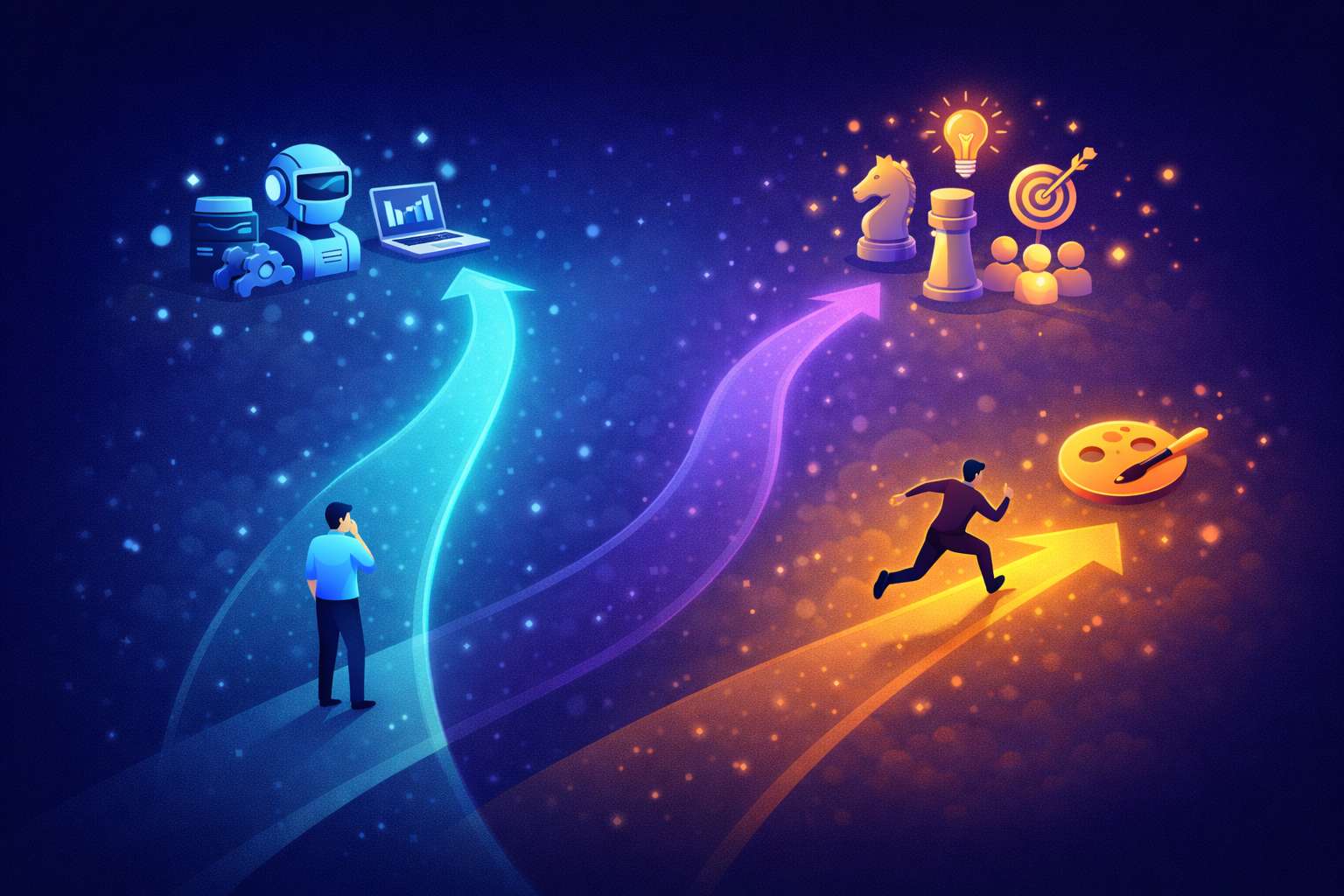
The 3 Paths of Career Change
1. Upskilling — Stay, but grow
Master AI tools within your existing profession. The accountant learns AI-assisted bookkeeping. The marketer learns AI-augmented content preparation. The HR specialist learns AI-based candidate screening.
This is the right path for most — because expertise is valuable, and AI gives it extra power.
2. Reskilling — New field, but related
Transitioning to a related area where existing knowledge is partially transferable. For example:
- Administrator → Project coordinator / Operations manager
- Translator → Localization specialist / AI output editor
- Data entry clerk → Data analyst / BI assistant
- Graphic designer → UX designer / AI prompt artist
The key: You're not starting from zero — your existing experience (industry knowledge, workflow familiarity, client relationships) is your greatest asset.
3. Full switch — New direction
Less common, but it happens: someone steps into an entirely different field. In these cases, bootcamps, mentoring programs, and project-based learning are most effective.
Important: A full switch is nothing to be ashamed of — but don't switch out of fear. Switch because the new direction attracts you, not because you're afraid of the old one.
The Connection Between Career Change and Self-Awareness
The foundation of successful career change is conscious decision-making:
 Where am I now?           What do I want?          What's the gap?
 ┌──────────────┐         ┌──────────────┐        ┌──────────────┐
 │ My skills     │         │ My interests │        │ Missing       │
 │ My experience │  ───▶   │ My values    │  ───▶  │ skills        │
 │ My strengths  │         │ My motivations│       │ Learning plan │
 └──────────────┘         └──────────────┘        └──────────────┘
         │                        │                       │
         └────────────────────────┴───────────────────────┘
                              │
                     ┌────────▼────────┐
                     │ CONSCIOUS CAREER │
                     │ DECISION         │
                     └─────────────────┘
This triple self-examination (skills, motivation, gap) is the foundation of every career decision — whether it's upskilling, reskilling, or a full switch.
Generational Differences — Same Challenge, Different Perspectives
Baby Boomer / Gen X (45+)
Advantage: Deep expertise, industry knowledge, professional network, problem-solving experience.
Challenge: Digital tool knowledge gap, the "I'm too old for this" myth, fear of identity loss.
Strategy: AI doesn't replace 20-30 years of experience — it gives it wings. An experienced professional + AI = what a junior couldn't achieve in 5 years. Experience is the biggest competitive advantage — when paired with openness.
Gen Y / Millennials (30-44)
Advantage: Good digital foundations, willingness to learn, career-building awareness.
Challenge: "Sandwich position" — needing to deepen expertise AND learn AI simultaneously, while building a family and career. Time shortage.
Strategy: Just-in-time learning. Don't "take a course" — integrate AI into your daily work. 10 minutes/day of deliberate AI use > a weekend bootcamp.
Gen Z (18-29)
Advantage: Natural digital fluency, openness, rapid tool learning.
Challenge: Lack of deep expertise and work experience. AI can simulate surface-level knowledge — but real depth takes years to build.
Strategy: Don't settle for "I use AI." Understand what you're doing. Professional depth + AI = the strongest combination. Invest in expertise — that's the other leg of the Pi model.
How to Assess Your Own Skill Gap
The 5-Step Self-Assessment Framework
Step 1: Task Inventory — What Do You Do Each Day?
Write a list of your weekly tasks. Next to each task, note:
- R (routine) — repetitive, rule-based, predictable
- C (creative) — requires original thinking, decisions, empathy
- H (hybrid) — partly routine, partly creative
If 70% of your tasks are R → your AI exposure is high. That's okay — but you need to be aware of it.
Step 2: Skill Map — What Are You Good At?
List your skills in three categories:
- What you do well AND enjoy → this is your core, build on it
- What you do well but don't enjoy → this can be automated, hand it to AI
- What you can't do but need to → this is the skill gap
Step 3: Market Assessment — What Does the Market Want?
Look at job postings in your field. What skills are they asking for that they didn't 3 years ago? Has AI, data analysis, digital tool knowledge appeared?
Step 4: Gap Identification — Where's the Gap?
Comparing Steps 2 and 3 reveals:
- You have what they want → strong position, but don't get complacent
- You don't have it, but it's learnable → this is your development plan
- You don't have it, and you're not interested → question of career change or specialization
Step 5: Learning Plan — How Will You Close the Gap?
You don't need to do everything at once. One skill, 3 months, a concrete goal. For example:
- "In 3 months, I'll learn to use ChatGPT in my work"
- "I'll complete a basic data analytics course"
- "I'll spend 1 hour each week trying out new AI tools"
The Importance of Regular Review
This isn't a one-time task. Your skill map should be reviewed quarterly:
- Have market expectations changed?
- Did I develop in the planned area?
- Has a new gap appeared that I didn't anticipate?
Your career isn't a straight line — it's a continuously replanned route.
Training in the AI Era — What, How, How Much?
The Transformation of the Training Market
Traditional education (3-year degrees, semesters, exams) can't keep pace with AI's speed of change. Instead, modular, continuous, targeted learning is needed:
Which Training Closes Which Gap?
The "Just-in-Time Learning" Principle
The most effective learning isn't studying something "just in case." It's when you solve a concrete problem, and learn in the process.
- Not "I'll take an AI course" → but "I'll try making this week's report with AI, and learn as I go"
- Not "I'll read a book about data analysis" → but "I'll analyze my team's data, and fill in what I'm missing"
The Organizational Side — What Can Employers Do?
The skill gap isn't just an individual problem — it's an organizational challenge too. Companies that don't invest in their team's development lose talent and fall behind competitively.
The Employer's 5 Responsibilities
- Skill audit: Assess what skills the team has — and where the gaps are
- Personalized development plans: Not everyone needs to learn the same thing
- Provide learning time: 2-4 hours of dedicated learning time per week — during work hours, not personal time
- Internal knowledge sharing: Those who've already learned teach the others (peer learning)
- Implement AI tools with support: Not "here's a tool, use it" — but guided rollout with mentoring
Building a Learning Culture
The most successful organizations don't "organize training" — they build a culture where learning is natural:
Skill Audit in Practice
An organizational skill gap assessment doesn't have to be complicated:
- Role analysis: What tasks make up the role? Which are automatable?
- Individual self-assessment: Team members rate their own skills (1-5 scale)
- Manager assessment: The manager adds their own perspective
- Gap map: Visual comparison of "needed" vs. "existing" skills
- Development plan: Personalized learning pathway for every team member
This isn't an annual performance review — it's a quarterly, brief, development-focused conversation.
Continuous Development — How to Do It Long-Term
The "Skill Sprint" Method
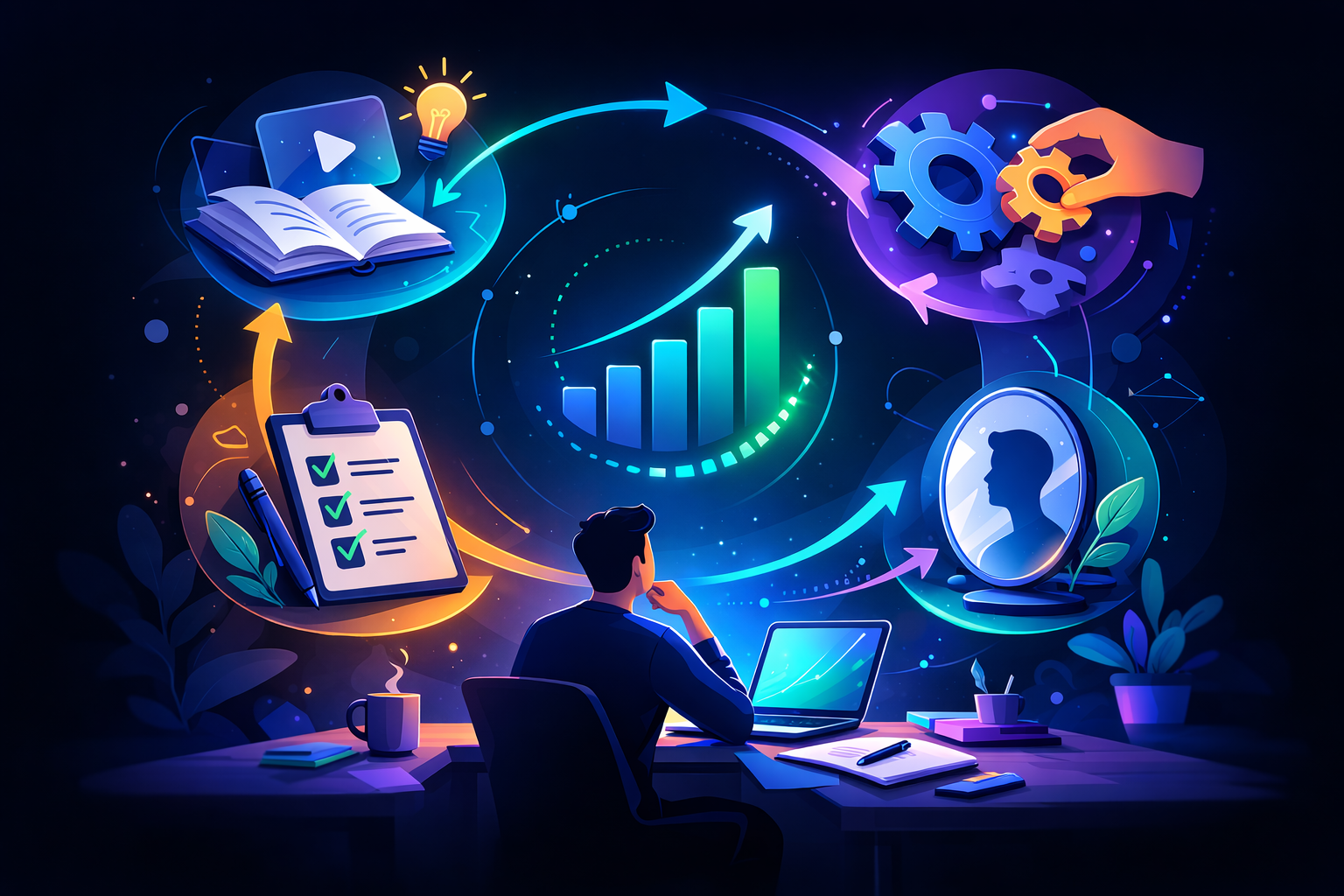
The traditional "complete a course, then I'm done" approach doesn't work in the AI era. Instead, we recommend the Skill Sprint method:
10-12 skill sprints per year = continuous, manageable growth. You don't need to do everything at once — small steps, consistently.
The Personal Skill Dashboard
It's worth keeping a simple "skill dashboard" — even on paper or in a spreadsheet:
┌─────────────────────────────────────────────────────┐
│                  SKILL DASHBOARD                     │
├──────────────┬──────────┬──────────┬────────────────┤
│ Skill        │ My Level │ Target   │ Next Step      │
│              │ (1-5)    │ Level    │                │
├──────────────┼──────────┼──────────┼────────────────┤
│ AI tools     │ ⭐⭐      │ ⭐⭐⭐⭐   │ ChatGPT sprint │
│ Data analysis│ ⭐⭐⭐     │ ⭐⭐⭐⭐   │ Google Cert    │
│ Presentation │ ⭐⭐⭐⭐    │ ⭐⭐⭐⭐   │ Maintenance    │
│ English      │ ⭐⭐⭐     │ ⭐⭐⭐⭐   │ 2× weekly pod  │
│ Leadership   │ ⭐⭐      │ ⭐⭐⭐     │ Find a mentor  │
└──────────────┴──────────┴──────────┴────────────────┘

Last review: March 2026
Next: June 2026
The point: Not perfection, but awareness. When you can see where you are, it's easier to decide where to go.
What Does This Mean for You?
If you're an employee:
- Create a skills inventory — be honest with yourself about what you're good at and where the gap is
- Choose the one skill that would have the biggest impact on your career in the next 3 months
- Start NOW — you don't need to find the perfect course, you just need to begin
- Don't be afraid that AI will take your job — but be afraid if you're not developing
If you're a CEO:
- The skill gap is your problem too — if your team doesn't develop, neither does your company
- Invest in training — technology isn't the bottleneck, people are
- Create a learning culture — where it's not shameful to not know, but shameful not to learn
If you're choosing a career path:
- Whatever profession you choose, AI skills will be a plus — whether it's doctor, lawyer, teacher, or craftsperson
- The most in-demand person of the future: someone who understands their field AND AI (Pi model)
- Self-awareness isn't a luxury — it's the foundation of your career
The Final Thought
The future can't be predicted precisely. But one thing we know for certain:
AI isn't taking your job. It's questioning the relevance of your skills.
Those who know themselves, know where the gap is, and are willing to learn — they don't fear change. They shape it.
Preparation isn't optional. Self-awareness isn't a luxury. Learning isn't a choice. And the best time is always now.
Want to explore how AI could help your business? Get in touch with us — we'll help you find the starting point with the fastest ROI.